Why Multi-Angle Video Data Improves Computer Vision Models
Computer vision models often fail not because they lack data, but because they lack perspective. Training on single-angle footage limits how well an AI system can generalize once objects, people, or environments appear from unfamiliar viewpoints.
Multi-angle video data solves this problem by exposing models to the same action or scene from multiple synchronized perspectives. This allows systems to learn spatial relationships, depth cues, and occlusion handling more effectively than single-camera datasets.
Perspective Matters in Real-World Deployment
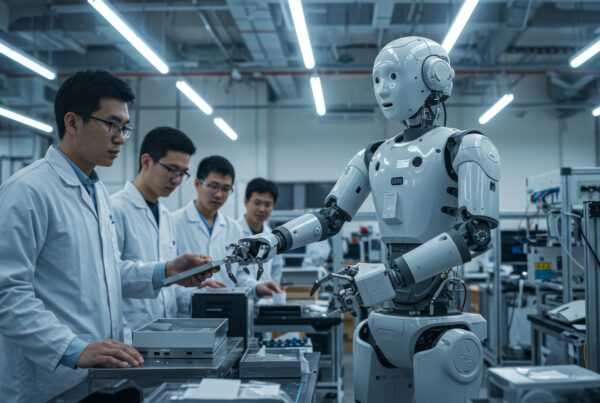
In real environments, robots and autonomous systems rarely encounter objects head-on. People approach from the side, move behind obstacles, or partially exit the frame. Without multi-angle training data, perception models struggle to maintain continuity when viewpoints change.
By training on synchronized camera feeds, models learn how actions and objects relate across angles, improving robustness in navigation, tracking, and recognition tasks.
Motion Consistency Across Views
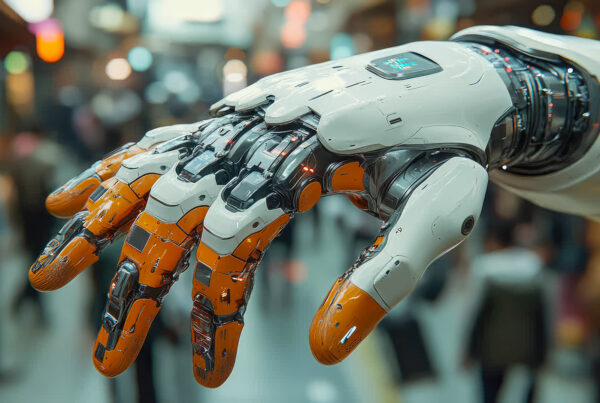
Video data captured from multiple angles allows AI systems to associate the same movement across viewpoints. A hand reaching for an object, for example, may look entirely different depending on camera placement, yet the underlying action is the same.
This consistency is critical for behavior recognition, pose estimation, and human-machine collaboration models, where understanding intent matters as much as identifying motion.
Reducing Occlusion and False Negatives
Single-camera datasets are especially vulnerable to occlusion. When key elements leave the frame or are partially blocked, models can lose context. Multi-angle capture reduces this risk by ensuring at least one camera maintains visibility during complex actions.
This approach significantly improves reliability in environments where people, objects, and machinery move simultaneously.
Building Perception Models That Scale
As AI systems scale beyond controlled spaces, they must adapt to unpredictable viewpoints and movement patterns. Multi-angle video data provides the variability necessary for that adaptation, improving model performance without relying on excessive post-training corrections.
MatchPoint AI supports robotics and AI teams by designing multi-angle video data collection pipelines that reflect real-world conditions, helping perception models generalize more effectively from training to deployment.