What does the physical world look like from a person’s perspective as they open a cabinet, repair equipment, cook a meal or move through a busy environment?
For AI developers, that first-person point of view can provide incredibly useful training data.
Smart glasses and wearable cameras allow data collection teams to record real-world activities from the perspective of the person performing them. Instead of watching someone from a fixed camera across the room, the camera moves with the participant and captures what appears in front of them as they interact with objects, tools and environments.
This type of wearable camera data can support robotics, embodied AI, augmented reality, computer vision and other AI systems that need to understand how people behave in the physical world.
But simply recording first-person video does not automatically create a useful dataset.
Camera position, field of view, task design, participant behavior, environmental variation and quality-control processes can determine whether captured footage becomes effective training data or just hours of unusable video.
What Is Wearable Camera Data for AI Training?
Wearable camera training data is visual information captured using cameras worn or attached to a person.
Common capture setups include:
- Smart glasses
- Head-mounted cameras
- Chest-mounted cameras
- Body-worn cameras
- Helmet-mounted cameras
- Wearable action cameras
- Custom first-person camera rigs
The footage produced by these systems is typically considered egocentric, meaning it captures an environment from approximately the same perspective as the person completing the activity.
That creates a very different dataset from traditional third-person video.
Consider someone assembling furniture.
A fixed camera positioned across the room may capture the person’s body, workspace and surrounding environment.
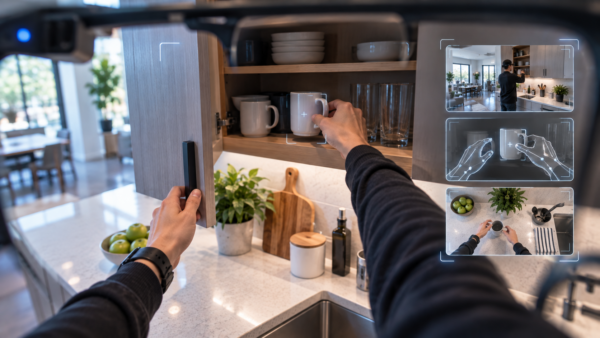
A wearable camera may instead capture their hands reaching toward a screwdriver, selecting a screw, positioning two components, rotating the tool and visually checking the finished connection.
Both views are valuable, but they provide different types of information.
For models learning physical interaction and manipulation, a close hands-in-view perspective can be especially useful.
Why Collect AI Training Data With Smart Glasses and Wearable Cameras?
First-person cameras create a direct relationship between what someone sees and what they do next.
That connection can be important for AI systems designed to understand, predict or interact with activity in real-world environments.
Wearable cameras can capture information such as:
- Which objects appear in a person’s field of view
- Which items a person reaches toward
- How hands interact with objects
- How tools are handled
- The sequence in which actions happen
- How the scene changes as someone moves
- How people navigate physical spaces
- Which objects become visible or obscured
- How visual attention shifts during a task
This makes wearable footage valuable for models that need to learn more than basic visual recognition.
Identifying a screwdriver is one task.
Understanding when a person reaches for that screwdriver, how they grasp it, what they use it for and what happens immediately afterward is a much more complex learning problem.
What Can AI Models Learn From First-Person Video?
The value of wearable video depends on the model’s training objective, but several applications are particularly well suited to first-person capture.
Hand-Object Interaction
Hands frequently play a central role in egocentric video.
Wearable cameras can capture actions such as reaching, grasping, releasing, rotating, pushing, pulling and manipulating objects at relatively close range.
This type of footage can support models learning:
- Hand tracking
- Object interaction
- Tool use
- Manipulation
- Action recognition
- Task forecasting
Ego4D, one of the largest public egocentric video research initiatives, includes benchmark tasks focused specifically on hands and objects. Its broader dataset contains thousands of hours of everyday activity captured from first-person cameras across many different scenarios.
Activity Recognition
Wearable footage can also show how individual actions combine to form complete tasks.
Preparing coffee, for example, might involve:
- Finding a mug
- Opening a cabinet
- Locating the coffee
- Preparing the coffee maker
- Adding water
- Positioning the mug
- Starting the brewing process
Instead of learning each step independently, an AI system can potentially use these sequences to understand how actions fit together as part of a larger task.
Object Recognition and Tracking
Objects can repeatedly enter and leave the camera’s field of view during first-person activities.
A model might need to understand that a spoon shown earlier is the same spoon that later appears on a countertop or inside a drawer.
That creates useful data for object detection, tracking, scene understanding and AI systems that incorporate memory.
Navigation
Because wearable cameras move naturally with the participant, they can capture changing physical environments as someone walks.
Footage may include:
- Hallways
- Rooms
- Doors
- Stairs
- Obstacles
- Other people
- Changing viewing angles
This can provide useful visual context for robotics, spatial computing and embodied AI applications.
Human Behavior Understanding
Wearable data can also reveal natural variations in how people complete the same task.
One person may organize everything before starting.
Another may reorganize items throughout the activity.
One participant may rely heavily on both hands, while another performs most actions using a dominant hand.
These natural behavioral differences can be difficult to recreate through highly rigid scripted demonstrations.
Smart Glasses vs. Other Wearable Camera Setups
Not every wearable camera creates the same type of dataset.
The best device depends on what information the AI system needs to learn.
Smart Glasses
Smart glasses position cameras relatively close to the wearer’s natural line of sight.
That can make them useful for collecting data involving:
- Everyday activities
- Object interaction
- Navigation
- Hands-in-view tasks
- AR and wearable AI
- Human attention
- First-person scene understanding
Research projects have already demonstrated the potential of glasses-based capture systems.
Meta’s Project Aria research device, for example, uses a glasses-style form factor that includes first-person video alongside additional sensor streams. Meta developed the platform to support research into machine perception and future augmented-reality systems capable of understanding the world around the wearer.
Head-Mounted Cameras
Dedicated head-mounted action cameras may offer different resolution, stabilization, recording and field-of-view options than smart glasses.
These devices can be useful when the primary objective is collecting high-quality first-person visual data rather than replicating the characteristics of a specific wearable product.
Chest-Mounted Cameras
Chest-mounted cameras capture activity from a lower position.
Depending on the task, they may provide strong views of hands and objects while reducing some of the rapid motion associated with cameras attached to the head.
The tradeoff is that chest-mounted footage may not accurately reflect what the participant is looking toward.
Helmet-Mounted Cameras
Industrial, construction and field-based projects may use cameras mounted directly to protective helmets.
This can provide first-person training data in environments where workers are already required to wear protective equipment.
Ultimately, the right setup depends on the activity, environment and downstream model requirements.
Wearable AI Data Can Include More Than Video
Wearable data collection does not have to be limited to visual footage.
Depending on the hardware and training objective, a project might also capture:
- Audio
- Inertial measurement unit data
- Accelerometer data
- Gyroscope data
- Eye gaze
- Depth information
- Position or pose information
- GPS
- Multiple synchronized camera feeds
Ego4D demonstrates the potential of this multimodal approach. In addition to thousands of hours of first-person video, portions of its dataset include audio, gaze information, stereo footage, 3D environmental information and synchronized camera perspectives.
Its original data collection also used several types of commercially available head-mounted cameras instead of relying on one standardized device.
Whether a commercial AI project needs those additional modalities depends entirely on the intended model.
Adding more sensors does not automatically make a dataset better.
The more important question is:
What information does the model need that visual footage alone cannot provide?
How Is Smart Glasses Training Data Collected?
Effective wearable data collection starts by defining the model’s requirements, not by choosing a camera.
1. Identify the Training Objective
Start by defining the behavior or capability the dataset should help teach.
For example:
Robotics: Human demonstrations involving object manipulation and task completion
Wearable AI: First-person environmental understanding and contextual assistance
Computer vision: Hand tracking, action recognition or object detection
AR: Understanding surfaces, objects, people and interactions around the wearer
Industrial AI: First-person footage of maintenance, assembly and tool use
Once the model objective is clear, the capture system can be designed around it.
2. Select the Right Camera Perspective
Small changes in camera positioning can significantly affect the usefulness of wearable footage.
A camera mounted too high may fail to capture the participant’s hands.
A camera pointed too far downward may capture detailed manipulation while losing important context about the surrounding environment.
Similarly, a very wide field of view can provide more environmental coverage while making small objects appear less prominent.
The capture configuration should be tested against real examples of the intended tasks before full-scale production begins.
3. Design the Activities
Some wearable datasets capture naturally occurring behavior.
Others rely on structured tasks designed specifically for the training objective.
A robotics collection might ask participants to:
- Pick up household objects
- Sort different items
- Open drawers
- Use common tools
- Fold clothing
- Prepare simple food
- Pack and unpack containers
- Move objects between locations
- Complete assembly tasks
The objective is often to define what must happen while leaving enough flexibility for participants to complete the activity naturally.
4. Maintain Visibility of Hands and Objects
For manipulation-focused datasets, framing matters.
Participants may naturally turn away from the camera, lower their hands outside the frame or obscure objects with their body.
Those actions are perfectly normal for a person but may reduce the usefulness of the resulting training data.
Pilot sessions can help determine whether cameras need to be repositioned or instructions adjusted so important actions remain visible without forcing participants to move unnaturally.
This is one area where professional production and capture experience can significantly improve dataset quality.
5. Include Multiple Participants
People perform physical activities differently.
Participant characteristics can vary in areas such as:
- Height
- Reach
- Hand size
- Dominant hand
- Movement speed
- Experience with the task
- Problem-solving approach
A dataset collected from only one person may unintentionally teach the model one individual’s preferred way of completing an activity.
Using multiple participants introduces more realistic behavioral variation.
6. Vary Objects and Environments
The same action can look dramatically different depending on the object being handled and the environment where it happens.
Consider opening a drawer.
A kitchen drawer, filing cabinet and industrial tool drawer involve the same general action but create very different visual conditions.
Custom data programs can intentionally vary:
- Locations
- Room layouts
- Object types
- Object colors
- Object placement
- Lighting
- Background clutter
- Tools
- Clothing
- Task sequence
The goal is not random variation. It is controlled diversity designed around the conditions the model is expected to encounter.
7. Collect Repeated Examples
AI systems typically need repeated examples of important actions.
The same task can be performed multiple times while individual variables change.
For example, someone might repeatedly pick up:
- A ceramic mug
- A plastic cup
- A metal bottle
- A clear glass
- A handled container
- A small container
- A large container
The core activity remains similar while visual and physical characteristics vary.
That creates a richer training set than repeatedly collecting an identical action with the exact same object.
When Should You Use Multiple Camera Angles?
First-person footage does not need to be collected in isolation.
For many training programs, combining wearable video with external cameras can make a dataset substantially more informative.
A project might record the same task using:
- First-person wearable video
- Frontal third-person video
- Side-angle footage
- Overhead footage
- A wide environmental view
The wearable camera captures what the participant encounters.
External cameras provide additional information about posture, body position and movement.
Together, those perspectives can provide a more complete representation of a physical activity.
Ego-Exo4D, a follow-up research initiative connected to Ego4D, was specifically built around synchronized egocentric and exocentric perspectives for understanding skilled human activities.
Commercial robotics programs may benefit from the same general principle even without reproducing the exact research setup.
Using Smart Glasses Data for Robotics and Embodied AI
Wearable camera data has particular relevance for robotics because humans and robots operate within many of the same physical environments.
First-person human footage can demonstrate:
- Reaching
- Grasping
- Object manipulation
- Tool use
- Navigation
- Task sequencing
- Hand coordination
- Interaction with the environment
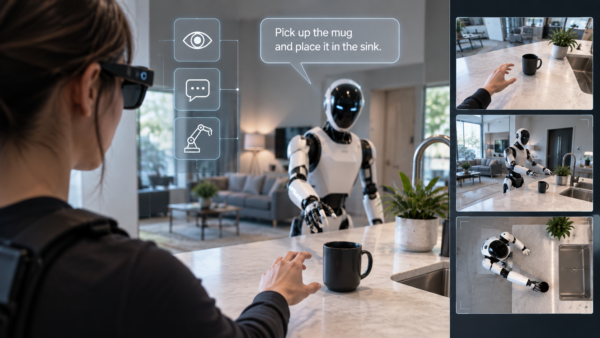
A humanoid robot learning household tasks, for example, may benefit from demonstrations showing how people interact with kitchens, appliances, furniture and common household objects.
Wearable cameras provide one useful visual perspective.
Additional sensors and external camera views can provide complementary information about body movement and physical interactions.
This does not mean a robot can watch a person perform an activity and immediately reproduce the same motion.
Human and robot bodies differ substantially.
But human demonstrations can still provide valuable information about objectives, objects, actions and task structure that can support embodied AI and robotics training pipelines.
Smart Glasses Data for AR and Wearable AI
Smart glasses create another compelling training scenario because the AI system may ultimately operate from nearly the same perspective used during data collection.
A wearable AI assistant may need to determine:
- What object the user is viewing
- What activity they are performing
- Where an item was last seen
- Which tool they are holding
- What changed in the environment
- Which information might be useful in the current context
These are inherently first-person problems.
Ego4D’s episodic memory benchmark, for example, explores whether AI can use a person’s previous first-person video experience to answer questions about things they encountered earlier.
As AI becomes more deeply integrated into wearable devices, datasets representing a user’s actual perspective and activities may become increasingly valuable.
Privacy and Consent in Wearable Data Collection
First-person cameras introduce data privacy considerations that may be less pronounced in controlled studio environments.
A wearable camera can continuously encounter:
- Other people
- Computer screens
- Documents
- Personal belongings
- Private spaces
- Addresses
- Reflections
- Sensitive information
Because of that, privacy and governance procedures should be incorporated into data collection planning from the beginning.
Depending on the project, requirements may include:
- Participant consent
- Location permissions
- Bystander protocols
- Restricted recording zones
- Data access controls
- Secure storage
- De-identification
- Dataset documentation
- Controlled transfer procedures
Both Project Aria and Ego4D have publicly discussed ethical and privacy considerations related to first-person data collection, illustrating how important these issues are for wearable research.
Commercial requirements will vary depending on the project, participants, jurisdictions and intended use of the dataset.
Public Egocentric Datasets vs. Custom Data Collection
Public first-person datasets have played an important role in advancing research around wearable AI.
However, public datasets cannot represent every commercial training requirement.
An existing dataset may not include:
- The device being developed
- The required camera angle
- The right objects
- Target environments
- Specific activities
- Desired participant characteristics
- Required technical specifications
- Enough examples of critical edge cases
Custom data collection allows these variables to be designed around a specific model.
An industrial AI developer, for example, may require first-person footage of workers completing specialized equipment procedures.
A robotics company may need thousands of demonstrations involving a narrow group of household objects.
A wearable AI company may need video captured from a very specific physical camera position that closely matches its eventual device.
Those requirements can be difficult or impossible to satisfy using general-purpose public datasets.
What Makes Wearable Camera Training Data Useful?
High-quality first-person datasets typically share several characteristics.
A Defined Training Objective
The data should support a specific model requirement rather than simply generating large quantities of footage.
The Right Perspective
The camera should consistently capture the visual information needed for the intended training task.
Strong Hands-in-View Coverage
For manipulation datasets, hands and relevant objects should remain visible during important portions of the activity.
Environmental Variety
Capture locations and conditions should reflect the environments the AI system is ultimately expected to encounter.
Participant Diversity
Using multiple participants introduces more natural variation in movement, behavior and task execution.
Technical Consistency
Resolution, frame rate, camera configuration and file-management standards should be established before collection begins.
Quality Control
Recorded footage should be reviewed for framing, task completion, technical integrity and project-specific requirements.
Structured Documentation
Files should include sufficient metadata to explain what was captured, how it was collected, where the activity occurred and under which conditions.
Wearable and First-Person AI Data Collection With MatchPoint AI
MatchPoint AI provides structured visual data collection for robotics, humanoids, autonomous systems and computer vision applications.
Our capabilities include multi-angle human activity capture, object manipulation, navigation behaviors, fine motor actions, tool use and multi-step tasks across residential, commercial and industrial environments.
Mobile production teams can also deploy into real-world locations required by the project rather than limiting data collection to one controlled studio environment.
That production background is particularly valuable for first-person capture.
Wearable datasets require careful camera planning, participant direction, repeatable task execution, location coordination and quality review. Depending on the model requirements, projects may also incorporate synchronized external cameras when a wearable perspective alone does not capture enough information.
MatchPoint AI works directly with project teams using structured quality-control, documentation and secure-delivery processes for AI data collection programs.
For projects requiring smart glasses, head-mounted cameras or another wearable setup, the appropriate device, perspective and production workflow can be built around the model’s requirements during planning.
The objective is not simply to record first-person footage.
It is to create first-person data that solves a defined AI training problem.
Frequently Asked Questions About Smart Glasses Training Data
What is smart glasses training data?
Smart glasses training data consists of first-person visual data, and potentially additional sensor information, collected using glasses-mounted hardware. It can support AI systems focused on scene understanding, object recognition, human activity recognition, robotics, augmented reality and wearable AI.
Why are wearable cameras useful for AI training?
Wearable cameras record the physical world from the perspective of the person performing an activity. This makes it possible to capture detailed information about hands, objects, actions, navigation and the sequence in which tasks occur.
Can wearable cameras collect hands-in-view training data?
Yes. Glasses-mounted and head-mounted cameras can record hands interacting with objects from a first-person perspective, making them useful for manipulation, action recognition and embodied AI datasets.
What activities can be captured using smart glasses?
Depending on the project, smart glasses can be used to capture household activities, assembly, cooking, tool use, workplace procedures, navigation, shopping, object manipulation and many other real-world tasks.
Is first-person wearable data useful for robotics?
Yes. Human first-person footage can provide demonstrations involving tool use, navigation, manipulation and multi-step activities that may support robotics and embodied AI development.
Should wearable datasets also include third-person video?
They can. Combining wearable footage with external camera views can provide additional information about body movement, surrounding objects and the broader environment.
Where can companies get custom wearable camera data for AI training?
Companies can build their own collection programs or work with an AI data collection partner that can design capture around specific tasks, environments, participants and technical requirements.
MatchPoint AI provides structured, real-world visual data collection for robotics, embodied AI, computer vision and other AI applications.
Training AI From a First-Person Perspective
Smart glasses and wearable cameras provide something many traditional datasets cannot: an approximation of how the physical world unfolds from the perspective of the person interacting with it.
Hands move into view.
Objects change position.
Environments shift as the wearer walks.
Tasks develop over seconds or minutes instead of being represented by a single static image.
For AI systems designed to understand human behavior, interact with real-world environments or eventually assist people through wearable technology, this perspective can be extremely valuable.
But useful first-person data requires more than attaching a camera to someone’s head.
It requires intentional task design, appropriate hardware, real-world diversity, consistent quality control and a clear understanding of the model’s training objective.
MatchPoint AI helps teams turn those requirements into structured, professionally captured visual datasets.
Need custom first-person or wearable camera data for an AI project? Contact MatchPoint AI to discuss your training data requirements.